Loading...
Shack-Hartmann Optical Metrology
Wavefront Sensors
From DUV (193 nm) to LWIR (10.6 μm) — Sub-Nanometer Precision to λ/1000 rms
SpotOptics engineers and manufactures the world's most versatile Shack-Hartmann wavefront sensors. Used worldwide in laser metrology, optical element testing, telescope alignment, automotive HUD validation, and high-volume contact lens production.
λ/1000
rms Repeatability
λ/60
Absolute Accuracy
193 nm
DUV Lithography
10.6 μm
LWIR CO₂ Testing
Working Principle
What Is a Wavefront Sensor?
A wavefront sensor measures the phase deviations (aberrations) across an optical pupil. Unlike interferometers requiring mirror-quality reference surfaces, Shack-Hartmann sensors directly measure wavefront slope using a micro-lenslet array.
Shack-Hartmann Lenslet Array (Modern Standard)
A precision micro-lenslet array subdivides the incident beam into an array of sub-apertures. Each lenslet focuses its portion of light onto a CMOS/InGaAs camera sensor. Local spot displacements from calibrated reference coordinates directly measure the wavefront gradient. Zernike polynomial expansion instantly reconstructs the complete phase map.
- ✓Single-frame capture: Immune to workshop and factory vibrations (no isolation table needed).
- ✓Broadband spectral range: Operates seamlessly from 193 nm DUV to 10.6 μm LWIR.
- ✓Large dynamic range: Up to ±50λ continuous aberration capture without phase unwrapping failure.
- ✓Real-time analysis: High-speed modal decomposition up to 500 Hz with SenSoft™ software.
Classical Hartmann Screen (Legacy)
The historical Hartmann test utilized an opaque mask perforated with pinholes placed before an optic. Spots were recorded on photographic plates or CCDs near focus. While conceptually related, the lenslet array replaced it completely:
- ✗Lower light throughput: Heavy absorption by opaque screen limits low-light utility.
- ✗Coarser spatial sampling: Fewer measurement sub-apertures across the pupil.
- ✗No lenslet optical gain: Weaker spot intensity and inferior centroiding resolution.
- ✗Cumbersome calibration: Requires complex manual alignment procedures.
Independent Metrology Validation: SpotOptics wavefront sensors have been rigorously tested against Zygo GPIxp HR and Veeco interferometers, demonstrating rms phase agreement within 2 nm rms (λ/300).
Read Validation Study →Instruments Range
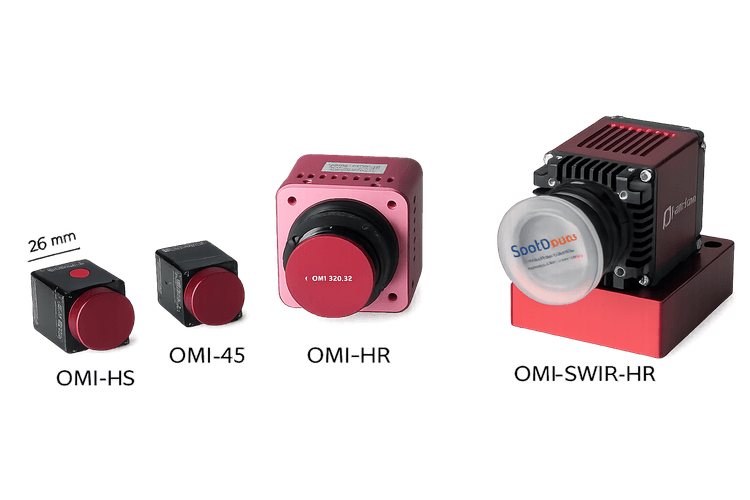
SpotOptics Sensor Product Family
Explore our full range of Shack-Hartmann wavefront sensors — from pocket-sized multi-pass units to high-resolution single-pass systems and dual-channel laser diagnostics.


Spectral Breadth
Wavelength Coverage: DUV to LWIR
No other optical metrology manufacturer offers this extensive spectral coverage in a unified software ecosystem.
DUV
193 – 350 nm
Deep Ultraviolet
ArF excimer laser metrology, semiconductor lithography optics, DUV stepper lens testing.
Compatible Models: OMI-DUV-HR
VIS
400 – 700 nm
Visible Light
Precision optical testing, imaging lens metrology, adaptive optics, telescope alignment at visible wavelengths.
Compatible Models: OMI-HS, Optino-mu, Optino
NIR
700 nm – 1.1 μm
Near Infrared
Telecom photonics, Nd:YAG laser qualification, silicon wafer inspection, fiber collimators.
Compatible Models: OMI-45, OMI-HR
SWIR
1.0 – 2.5 μm
Short-Wave Infrared
InGaAs detector sensors for SWIR surveillance optics, LIDAR beam characterization, night-vision lenses.
Compatible Models: OMI-SWIR-HR
MWIR
3 – 5 μm
Mid-Wave Infrared
Thermal imaging lens characterization, MWIR detector testing, aerospace EO/IR payload qualification.
Compatible Models: OMI-MWIR
LWIR
8 – 10.6 μm
Long-Wave Infrared
High-power CO₂ industrial laser beam quality (10.6 μm), thermal infrared telescope optics, LWIR aspheres.
Compatible Models: OMI-LWIR
Technology Comparison
Shack-Hartmann vs. Interferometer
A direct technical benchmark to help optical engineers choose the optimal metrology solution.
| Criterion | 🔬 Shack-Hartmann (SpotOptics) | 💡 Fizeau / Twyman-Green Interferometer |
|---|---|---|
| Absolute Accuracy | λ/60 (OMI), λ/40 (SWIR) | λ/100 to λ/500 |
| Repeatability (rms) | λ/1000 | λ/1000 – λ/2000 |
| Vibration Immunity | ✅ Excellent (single-frame) | ❌ Needs isolation table |
| Wavelength Flexibility | ✅ 193 nm – 10.6 μm | ❌ Fixed source wavelength |
| Dynamic Range | ±50λ (tilt subtracted) | ±λ/4 to ±5λ |
| Cost | 💰 Lower (no reference flat) | 💰💰 Higher |
| Setup Complexity | Low — USB3 plug-and-play | High — alignment-critical |
| Calibration | In-situ by user | Reference flat required |
| Form Factor | Pocket-size (200 g, Optino-mu) | Bench-top only |
| Software | SenSoft™ (included) | Vendor-locked |
When to choose Shack-Hartmann: Vibration-sensitive environments, broadband or non-laser sources, large dynamic range requirements (up to ±50λ), portable production line testing, or fast turnaround.
When interferometry is required: Ultra-smooth surface roughness metrology (λ/200+) where traceable reference flats and vibration-isolated tables are readily available.
Industrial & Research
Key Applications
SpotOptics Shack-Hartmann sensors are deployed across deep-tech industries, national observatories, and defense laboratories worldwide.
HUD & Automotive Optics
Wavefront aberration testing of Head-Up Display projection lenses, automotive camera modules, and ADAS optical assemblies.
HUD Testing Guide →Telescope Active Optics & Alignment
Active optics and real-time alignment of astronomical telescope primary and secondary mirrors (active since ESO NTT 1989).
Telescope Alignment Guide →Laser Beam Quality (M² & MTF)
Single-shot extraction of M² beam quality and Modulation Transfer Function directly from Shack-Hartmann data without mechanical scanning.
Laserino-mu Details →Optical Lens & Asphere Metrology
Single and double-pass transmission and reflection testing of lenses, mirrors, prisms, and aspherical optical surfaces across DUV to LWIR.
Optino Metrology →Ophthalmic & Contact Lens QC
Production-line contact lens metrology — measuring dioptric power, astigmatism, higher-order Zernike aberrations, and MTF in wet or dry state.
Contour Instrument →Infrared & Thermal Imaging Metrology
MWIR and LWIR wavefront characterization for military thermal camera lenses, drone EO/IR sensors, and industrial CO₂ laser optics.
OMI Infrared Sensors →Software Platform
SenSoft™ Analysis Intelligence
Every SpotOptics Shack-Hartmann wavefront sensor is powered by SenSoft™ — our proprietary, hardware-synchronized optical measurement and modal expansion suite.
Explore SenSoft™ Software →Up to 500 Hz
Real-Time Acquisition
Hardware-synchronized simultaneous capture and slope integration across both wavefront and imaging channels.
4 Polynomial Sets
Zernike Modal Fitting
Full support for Standard, Annular, Fringe, and Seidel polynomial expansions with selectable order.
Instant Output
M² & MTF Calculation
Instant beam quality factor and MTF curves calculated directly from Shack-Hartmann phase gradients — no scanning required.
Integrated Suite
Optical Simulation Tool
Simulate lenslet array pitch, spot dynamic range, and detectability limits prior to experimental setup.
Engineering FAQ
Frequently Asked Questions
Essential engineering clarifications for teams specifying Shack-Hartmann wavefront sensors. For more detailed answers, consult our Technical FAQ section →
What is a Shack-Hartmann wavefront sensor and how does it work?+
A Shack-Hartmann wavefront sensor uses a precision lenslet array placed in the pupil plane to convert wavefront slope into measurable spot displacements on a camera sensor. Each micro-lens focuses a sub-aperture of the incoming beam; displacements from reference positions are fit to Zernike polynomials to reconstruct the full wavefront in real time — up to 500 Hz with SenSoft™ software.
What is the accuracy of a Shack-Hartmann wavefront sensor?+
SpotOptics OMI sensors reach λ/60 absolute accuracy with λ/1000 rms repeatability. The Optino-mu achieves λ/3000 Zernike precision. Results have been independently validated against Zygo GPIxp HR and Veeco interferometers — agreement within 2 nm rms.
How does a Shack-Hartmann wavefront sensor compare to an interferometer?+
Key advantages: single-frame capture gives vibration immunity without isolation tables; broad spectral coverage (193 nm–10.6 μm) vs. fixed single laser wavelength; ±50λ dynamic range vs. ±5λ; no reference optical flat needed; and pocket-portable form factor (200 g Optino-mu).
What wavelength ranges are available?+
DUV (193–350 nm), Visible (400–700 nm), NIR (700 nm–1.1 μm), SWIR (1.0–2.5 μm, InGaAs), MWIR (3–5 μm), and LWIR (8–10.6 μm). Multi-wavelength models allow testing at multiple wavelengths simultaneously.
Can a wavefront sensor measure M² and MTF without scanning?+
Yes — the Laserino-mu dual-channel sensor extracts M² beam quality and MTF curves directly from Shack-Hartmann data in a single acquisition. No z-scan or slit scanner needed. Analysis is done in real time by SenSoft™ software.
Discuss your optical measurement challenge
Our technology team can help configure the right wavefront sensing, analysis software, and metrology solution for your application.