Loading...
Precision Optical Metrology & Adaptive Optics
Shack-Hartmann Wavefront Sensors: Sub-Nanometer Optical Metrology from DUV to LWIR
DUV (193 nm) to LWIR (10.6 μm) — λ/1000 rms Precision, Direct M² & MTF Diagnostics
SpotOptics engineers laboratory-grade and production-line Shack-Hartmann wavefront sensors delivering up to λ/1000 rms repeatability and λ/60 absolute accuracy. Deployed worldwide in laser metrology, telescope active optics, automotive HUD validation, and high-precision ophthalmic optics.
λ/1000
rms Repeatability
λ/60
Absolute Accuracy
193 nm
DUV Lithography
10.6 μm
LWIR CO₂ Metrology
Working Principle
Micro-Lenslet Array Spot-Displacement Mechanics vs Classical Hartmann Screen
A Shack-Hartmann wavefront sensor measures the phase distribution across an optical pupil by discretizing the incoming wavefront into local sub-apertures. Focal spot displacements directly yield local phase slopes, reconstructed via Zernike polynomial expansion without requiring a reference mirror.
Shack-Hartmann Lenslet Array (Modern Standard)
A precision micro-lenslet array focuses sub-apertures of the transferred pupil onto a CMOS or InGaAs matrix. Local spot displacements (Δx, Δy) from calibrated reference positions are directly proportional to the local wavefront gradient:θ_x = Δx / f_LA = (1/k) · (∂Φ/∂x)Real-time modal reconstruction via SenSoft™ yields complete spatial phase topography and Zernike aberration coefficients.
- ✓Single-frame snapshot: Immune to industrial vibrations and air turbulence (no vibration isolation tables required).
- ✓Broadband spectral flexibility: Continuous coverage from 193 nm DUV to 10.6 μm LWIR.
- ✓Large dynamic range: Captures up to ±50λ continuous wavefront error without 2π fringe ambiguity.
- ✓Real-time reconstruction: Up to 500 Hz modal decomposition into Standard, Annular, and Fringe Zernike polynomials.
Classical Hartmann Screen (Legacy Mask)
The historical Hartmann test utilized an opaque screen perforated with pinholes placed before the test optic. While conceptually related, the classical screen has been rendered obsolete by micro-lenslet technology:
- ✗Severe light starvation: Over 95% of incoming light is absorbed by the opaque screen, limiting low-light metrology.
- ✗Diffraction blur: Pinhole apertures produce diffuse geometric spots with low signal-to-noise ratio.
- ✗No optical focusing gain: Lacks refractive sub-aperture lens focusing, degrading centroiding resolution.
- ✗Cumbersome alignment: Demands labor-intensive manual alignment and restricted spatial sampling.
Independent Metrology Validation: SpotOptics Shack-Hartmann wavefront sensors have been cross-benchmarked against industry-standard Zygo GPIxp HR and Veeco Fizeau interferometers, achieving rms phase agreement within 2 nm rms (λ/300).
Read Validation Study →Spectral Breadth
Spectral Range Matrix: DUV (193 nm) to LWIR (10.6 μm)
No other optical metrology manufacturer offers this extensive spectral breadth within a unified hardware and software ecosystem.
DUV
193 – 350 nm
Deep Ultraviolet
ArF excimer laser metrology, semiconductor lithography optics, DUV stepper lens qualification.
Compatible Models: OMI-DUV-HR
VIS
400 – 700 nm
Visible Light
Precision optical testing, imaging lens metrology, consumer camera modules, freeform optics.
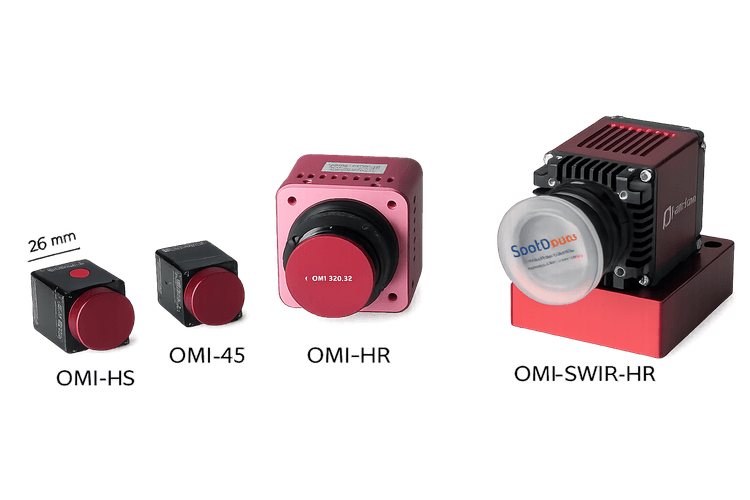
Compatible Models: OMI-HS, Optino-mu, Optino
NIR
700 nm – 1.1 μm
Near Infrared
Telecom photonics, Nd:YAG laser qualification (1064 nm), silicon wafer inspection, fiber collimators.
Compatible Models: OMI-45, OMI-HR, Laserino-mu
SWIR
1.0 – 2.5 μm
Short-Wave Infrared
InGaAs detector sensors for SWIR surveillance optics, LIDAR beam characterization, night-vision lenses.
Compatible Models: OMI-SWIR-HR
MWIR
3 – 5 μm
Mid-Wave Infrared
Thermal imaging lens characterization, MWIR detector testing, aerospace EO/IR payload qualification.
Compatible Models: OMI-MWIR
LWIR
8 – 10.6 μm
Long-Wave Infrared
High-power CO₂ industrial laser beam quality (10.6 μm), thermal infrared telescope optics, LWIR aspheres.
Compatible Models: OMI-LWIR
Instruments Lineup
SpotOptics Shack-Hartmann Wavefront Sensor Family
Engineered in Padova, Italy — from pocket-sized dual-pass units to high-resolution transmission systems and dual-channel laser diagnostics.


Metrology Benchmark
Shack-Hartmann Wavefront Sensor vs. Fizeau / Twyman-Green Interferometer
A rigorous technical benchmark to assist optical engineers, metrologists, and system integrators in selecting the optimal measurement platform.
| Performance Criterion | 🔬 Shack-Hartmann (SpotOptics) | 💡 Fizeau / Twyman-Green Interferometer |
|---|---|---|
| Vibration Insensitivity | Complete immunity: single-frame snapshot (10 µs – 10 ms) freezes vibration | Extremely vulnerable: requires pneumatic tables & acoustic isolation |
| Dynamic Range | Wide: ±50λ continuous aberration capture without phase ambiguity | Narrow: ±λ/4 to ±5λ; prone to phase unwrapping errors |
| Wavelength Versatility | Broadband: 193 nm to 10.6 µm with polychromatic or laser sources | Monochromatic: locked to fixed laser line (He-Ne 632.8 nm) |
| Absolute Accuracy | λ/60 PV (OMI Series) | λ/40 (Infrared) | λ/100 to λ/500 PV (under ideal laboratory conditions) |
| Repeatability (rms) | λ/1000 rms | λ/3000 Zernike precision (Optino-mu) | λ/1000 to λ/2000 rms (in climate-controlled cleanroom) |
| Reference Optics Required | None: in-situ software calibration with spherical/plane reference | Mandatory: calibrated master transmission sphere/flat ($$$) |
| Laser M² & Wavefront | Simultaneous: instant M², MTF & phase in single shot (Laserino-mu) | Not supported: requires secondary motorized scanning stages |
| Setup & Alignment | Low complexity: USB3 plug-and-play, wide angular tolerance | High complexity: precision cavity alignment required |
| Form Factor & Portability | Ultra-compact: 70×25×30 mm, 200 g (Optino-mu) portable unit | Bulky: 15–40 kg heavy benchtop chassis only |
| Capital Cost | Cost-effective: no expensive reference flats or isolation tables | High capital investment + ongoing recalibration costs |
When to choose Shack-Hartmann: Industrial shop-floor testing, laser beam quality analysis (M²), broadband/multi-wavelength testing, large wavefront aberrations (up to ±50λ), and space-constrained OEM test benches.
When interferometry is required: Sub-angstrom surface roughness metrology (λ/200+ PV) where reference transmission spheres and pneumatic isolation tables are readily available.
Industrial & Research
High-Impact Metrology Applications
SpotOptics Shack-Hartmann sensors are deployed across deep-tech industries, national observatories, and defense laboratories worldwide.
HUD & Automotive Optics
Wavefront aberration testing of Head-Up Display projection lenses, automotive camera modules, and ADAS optical assemblies without vibration artifacts.
HUD Testing Guide →Telescope Active Optics & Alignment
Active optics feedback and real-time collimation of astronomical telescope primary and secondary mirrors (heritage from ESO NTT 1989).
Telescope Alignment Guide →Laser Beam Quality (M² & MTF)
Instantaneous extraction of M² beam propagation factor and Modulation Transfer Function directly from single-shot phase data without mechanical scanning.
Laser Diagnostics Details →Optical Lens & Asphere Metrology
Single and double-pass transmission and reflection testing of lenses, prisms, and aspherical optical surfaces across DUV to LWIR.
Optino Metrology →Ophthalmic & Contact Lens QC
Production-line contact lens metrology — measuring dioptric power, astigmatism, higher-order Zernike aberrations, and MTF in wet or dry cells.
Contour Instrument →Infrared & Thermal Imaging Metrology
MWIR and LWIR wavefront characterization for military thermal camera lenses, drone EO/IR sensors, and industrial CO₂ laser optics.
OMI Infrared Sensors →Software Platform
SenSoft™ Analysis Intelligence
Every SpotOptics Shack-Hartmann wavefront sensor is powered by SenSoft™ — our proprietary, hardware-synchronized optical measurement and modal expansion suite.
Explore SenSoft™ Software →Up to 500 Hz
Real-Time Acquisition
Hardware-synchronized simultaneous capture and slope integration across both wavefront and imaging channels.
4 Polynomial Sets
Zernike Modal Fitting
Full support for Standard, Annular (central obscuration), Fringe, and Seidel polynomial expansions.
Single-Shot Output
M² & MTF Calculation
Beam quality factor (M²) and MTF curves calculated directly from phase gradients without translation stages.
Developer APIs
Automation & SDK
Full API support for Python, C++, C#, MATLAB, and LabVIEW with hardware TTL trigger synchronization.
Engineering FAQ
Frequently Asked Technical Questions
Authoritative technical clarifications for optical engineering teams specifying Shack-Hartmann wavefront sensors. For additional guides, explore our Technical FAQ Library →
What measurement repeatability and rms accuracy do SpotOptics Shack-Hartmann wavefront sensors achieve?+
SpotOptics Shack-Hartmann wavefront sensors achieve a wavefront repeatability of λ/1000 rms and an absolute accuracy of λ/60 PV across standard pupil apertures (in the OMI and Optino series). In individual Zernike modal coefficient repeatability, our instruments reach λ/3000 rms. These metrology specifications have been independently corroborated through cross-validation against industry-standard Zygo GPIxp HR and Veeco Fizeau interferometers, exhibiting spatial phase deviation agreements within 2 nm rms (approx. λ/300).
Why are Shack-Hartmann sensors preferred over Fizeau laser interferometers in industrial production environments?+
Traditional Fizeau and Twyman-Green interferometers rely on temporal phase-shifting across multiple consecutive frames. Any shop-floor vibration, acoustic disturbance, or thermal air turbulence scrambles interference fringes, requiring dedicated pneumatic vibration isolation tables and enclosed cleanrooms. In contrast, SpotOptics Shack-Hartmann sensors employ single-frame snapshot slope integration with exposure times down to 10 microseconds. This freezes mechanical vibrations completely, allowing direct mounting on manufacturing lines, robotic end-effectors, and open optical benches without isolation tables.
How fast is real-time wavefront reconstruction, and which Zernike polynomial sets are supported in SenSoft™?+
Reconstructed wavefront frames are processed at rates up to 500 Hz using GPU-accelerated and optimized C++ slope integration algorithms in SenSoft™. The software natively computes four polynomial expansions: (1) Standard Zernike Polynomials for circular pupils, (2) Annular Zernike Polynomials for optics with central obscurations like Cassegrain telescopes, (3) Fringe Zernike Polynomials for 1:1 cross-software benchmarking with interferometers, and (4) Seidel Polynomials for immediate geometrical third-order aberration metrics (Spherical, Coma, Astigmatism, Defocus, Distortion).
How does SpotOptics handle wavelength calibration and chromatic aberration across broadband or non-standard wavelengths?+
Because Shack-Hartmann sensors measure geometric wavefront slopes (θ = Δx / f_LA), the lenslet focal length is the primary wavelength-dependent factor, governed by refractive dispersion n(λ). SpotOptics embeds calibrated refractive dispersion tables inside SenSoft™ for all supported substrate materials (fused silica, silicon, Germanium, ZnSe). Users can also perform in-situ software calibrations using reference point sources within minutes.
Can SpotOptics wavefront sensors be integrated into custom automated optical test benches and OEM production lines?+
Yes. All SpotOptics instruments feature C-mount interfaces, 30 mm / 60 mm cage-mount compatibility, and M4/M6 optical breadboard taps. For automation, SenSoft™ provides a comprehensive developer API with native dynamic-link libraries (DLLs) and wrappers for Python, C++, C#, MATLAB, and National Instruments LabVIEW, along with hardware TTL trigger lines for synchronization with pulsed lasers and automated production equipment.
B2B Metrology Consultation
Discuss Your Optical Test Bench with Senior Optical Physicists
Whether qualifying extreme UV lithography lenses, characterising high-power CO₂ laser systems, or automating automotive HUD test lines, our Padova engineering team configures custom lenslet pitches, focal lengths, and spectral configurations.
Discuss your optical measurement challenge
Our technology team can help configure the right wavefront sensing, analysis software, and metrology solution for your application.